

Interstate Medical Licensure Compact: what changes for locum and telehealth credentialing
A locum physician's file arrives with a letter of qualification from her home state board and four new state licenses, all obtained through the Interstate Medical Licensure Compact within a few weeks. Four matches the average: the Interstate Medical Licensure Compact Commission recorded 4.0 licenses per applicant across applications completed between April 1, 2025 and March 31, 2026 [1].
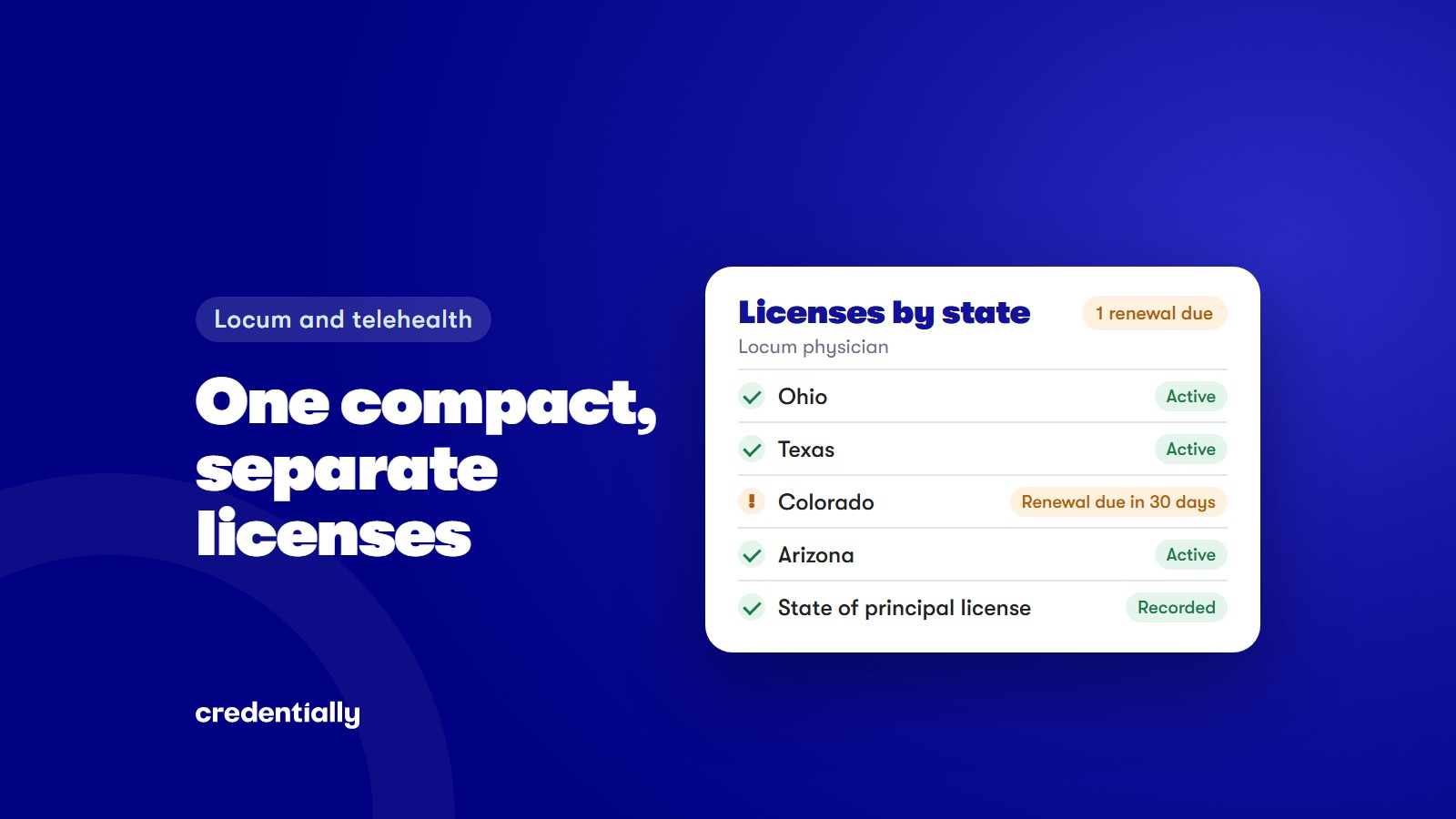
Each of those is a full license issued by one state board, and the Commission itself issues none [2], so your team still verifies each license at its own board. What the Compact adds is a link: under the model Compact text, an order against one license can change the status of the others [3].
The Commission's membership details, figures, fees and rules in this post are as read on its site on November 11, 2026, ahead of its annual meeting on November 16 and 17, 2026 [4].
Each license issued through the Interstate Medical Licensure Compact is a full state license
The Commission's FAQ says so directly: "The licensing is all state-based" [2]. The Compact also leaves each state's Medical Practice Act and board authority unchanged [2].
As of October 31, 2026, the Commission counted 44 states, the District of Columbia and Guam as members, with 59 licensing boards [4]. Participation is uneven. In 39 of those states, plus the District of Columbia and Guam, the board both acts as a state of principal license and issues licenses. Hawaii and Vermont issue licenses but cannot act as a state of principal license, and Alaska, New Mexico and Rhode Island have passed the Compact without yet issuing [4]. California, Massachusetts, New York, Oregon, South Carolina and Virginia are outside it [5].
For telehealth, the rule that matters is in Section 1 of the model text, which "affirms that the practice of medicine occurs where the patient is located at the time of the physician-patient encounter" [3]. Under that text, a telehealth physician comes under the medical board of each state where their patients are.
Eligibility depends on the state of principal license, and 7 percent of applications fail
Every application starts in one member state, the state of principal license. The rules require a full, unrestricted license there and one of four ties: primary residence, at least 25 percent of the physician's practice over the preceding six months, the employer's location, or, failing those, the state of residence for federal income tax [6]. The employer tie excludes an employer whose only presence in the state is a registration with the Secretary of State or a registered agent [6], so an agency's state of registration does not qualify on that basis alone.
The physician also has to pass credential and record tests, such as specialty board certification and no license ever disciplined other than for unpaid fees [7]. Board certification is tested at entry only and need not be maintained for the Compact [7][2], so Compact participation says nothing about whether a certificate is current.
The board in the state of principal license verifies those qualifications at the primary source, then issues a letter of qualification or notifies the Commission that the applicant is ineligible [2]. In the Year 9 data study, 7 percent of applications ended with a finding that the physician did not meet the eligibility requirements [1]. The letter is valid for 365 days with no waiver, after which adding states means reapplying and paying a new application fee [7][2].
What the Interstate Medical Licensure Compact costs and how long it takes
The Commission's Year 9 data study covers applications completed between April 1, 2025 and March 31, 2026 [1]. From application received to letter of qualification issued took 38 days on average, with 55 percent issued in 30 days or less. From the date a physician was found qualified to the date the requested licenses were issued took a further 22 days on average, with 47 percent complete in 7 days or less [1].
Both figures are averages, and the rules set no number of days for either stage [7], so there is no guaranteed processing time. The rules also note that the word expedited "does not refer to the speed of the process by which the state of principal license qualifies an applicant" [7]. Neither stage includes your facility's own credentialing and privileging, and no published study measures whether Compact licensing shortens that work. Fit both stages into a provider credentialing timeline worked backward from the start date.
The application fee is $700 and non-refundable, even if the physician is found ineligible, with $300 going to the board in the state of principal license and $400 to the Commission [8][2]. The applicant also pays for the background check [7], at a cost the Commission does not publish. Each state license costs extra, at a fee the state board sets; on the Commission's table read November 11, 2026, those fees ran from $35.00 for a Pennsylvania M.D. license to $895.00 for Texas [8][9]. Adding states while the letter is valid costs $100 per request plus state fees, and each renewal through the Compact carries a $25 Commission fee on top of the state's renewal fee [8].
As an illustration worked from that table, an M.D. requesting licenses in Texas, Florida, Colorado and Ohio would pay $700.00 plus state fees of $895.00, $355.00, $362.00 and $308.50: $2,620.50 before the background check [9]. The Commission publishes no such total.
Verify each state license at the board that issued it
The Compact gives your credentialing team no central record to check. Under Section 8(f) of the model text, information provided to the Commission or distributed by member boards is confidential, "filed under seal, and used only for investigatory or disciplinary matters" [3]. No public source describes a way for an employer to confirm a letter of qualification or a license through the Commission.
The verification behind the letter binds the other licensing boards: static qualifications such as medical education and examination results "shall not be subject to additional primary source verification where already primary source verified by the state of principal license" [3]. No public source states whether a hospital, health plan or staffing agency may rely on the letter of qualification for its own credentialing. Nor does any source state whether a state board's public license record shows that a license was issued through the Compact.
Medicare guidance, last revised September 16, 2021, treats licenses obtained through the compact pathway as valid, full licenses and states: "We'll continue to rely on the license the state medical board issues to confirm compliance with our federal license requirements" [10]. The National Association Medical Staff Services, which counts staffing and locum tenens companies among the organizations that credential, names state licensing boards as primary sources. Its best practice standards are explicit on location: "Ensure current license in every state where the patient is located" [11].
The facility side, including credentialing by proxy for telemedicine, is covered in why locum tenens credentialing starts over at every facility. Controlled substances need their own step: the Drug Enforcement Administration's registration guidance says a practitioner with a practice in more than one state needs a separate registration in each [12].
Licenses issued through the Compact are tied to the state of principal license
Three provisions of the model Compact law on the Commission's site link these licenses [3].
Section 5(f) covers a lapse. If the physician lets the license in the state of principal license go for a non-disciplinary reason without designating a new one, "An expedited license obtained through the Compact shall be terminated" [3]. The Commission's redesignation page says physicians generally have 90 days to redesignate [13].
Under Section 10(b), discipline in the state of principal license carries across. When that license is revoked, suspended, or surrendered or relinquished in lieu of discipline, all licenses issued to the physician by member boards "shall automatically be placed, without further action necessary by any member board, on the same status" [3].
Section 10(d) extends this, for a set period, to the same actions by any other member board. The physician's licenses from the remaining member boards are suspended "automatically and immediately" for 90 days from that board's order, so each can investigate under its own medical practice act, and a board may end the suspension of its own license sooner [3].
The practical effect is that a license your team verified as active can change status because of an order in a state where the physician has never worked for you. No source documents how quickly an automatic change reaches each board's public license lookup. Each license also runs on its own state's licensure period, and the rules make renewal the physician's responsibility even if no renewal notice arrives [7]. See recredentialing and revalidation deadlines for why those expirations follow no pattern.
Alongside what a complete credentialing file contains, hold one line per license: issuing state, license type and number, status, issue and expiration dates, whether it came through the Compact, which state is the state of principal license, and the date last verified at the board. For the general case, see how a license status changes between checks.
Monitoring each state license once the physician is working
Credentially monitors license status and document expirations in the background, alerting your team when something changes or needs action. Each check is recorded as it happens, so ongoing compliance does not depend on someone remembering to look. Agents can verify licenses and follow up candidates, and you decide what each agent can do on its own and what must come back to a person for approval. The state of principal license, and which licenses came through the Compact, come from the physician, so ask for both and record them in the file.
Map the licenses issued through the Compact on your roster
List every physician you place or employ who holds licenses in more than one member state, with the state of principal license and the licenses that came through the Compact recorded against each name. Then confirm each license at its issuing board and note the date. That list shows where one board's order would reach. Bring it to a demo and see license status tracked for physicians licensed through the Interstate Medical Licensure Compact.
Frequently asked questions
Does the Interstate Medical Licensure Compact give a physician one license for every member state?
No. The Compact is another pathway to full state licenses. The physician holds a separate license from each member state they choose and pay for, each renewed on that state's own term. As of October 31, 2026, the Commission counted 44 states, the District of Columbia and Guam as members.
How long does licensing through the Interstate Medical Licensure Compact take?
The Commission's Year 9 data study, covering April 1, 2025 to March 31, 2026, reports an average of 38 days from application to letter of qualification, then a further 22 days on average to the requested licenses. These are averages with no guaranteed processing time, and neither includes a facility's own credentialing.
Do we still need to verify each state license if a physician applied through the Compact?
Verify each license at the state board that issued it. Medicare guidance relies on the license the state medical board issues, and the National Association Medical Staff Services names state licensing boards as primary sources. No public source states whether a facility or staffing agency may rely on the letter of qualification.
What happens to a physician's other licenses if one Compact state disciplines them?
Under the model Compact text, revocation, suspension or surrender in lieu of discipline in the state of principal license places every license issued by other member boards on the same status automatically. The same action by any other member board suspends the physician's licenses from the remaining member boards for 90 days while those boards investigate, unless a board ends its own suspension sooner.
References
- Interstate Medical Licensure Compact Commission, IMLCC Data Study Year 9, Information Release, June 10, 2026, https://imlcc.com/wp-content/uploads/2026/09/IMLCC__Year9_DataStudyFinal_Revised.pdf
- Interstate Medical Licensure Compact Commission, General FAQs, no date shown, read November 11, 2026, https://imlcc.com/faqs/
- Interstate Medical Licensure Compact Commission, IMLC Compact Law, model legislation, undated, uploaded 2021, https://imlcc.com/wp-content/uploads/2021/02/IMLC-Compact-Law.pdf
- Interstate Medical Licensure Compact Commission, Homepage, IMLCC Snapshot Stats and U.S. State Participation in the Compact, updated November 2, 2026 with information as of October 31, 2026, https://imlcc.com/
- Interstate Medical Licensure Compact Commission, FY2026 Annual Report, October 2026, https://imlcc.com/wp-content/uploads/2026/10/IMLCC_AnnualReport_2026_webvf.pdf
- Interstate Medical Licensure Compact Commission, IMLCC Rule, Chapter 4, State of Principal License, amended May 13, 2025, https://imlcc.com/wp-content/uploads/2025/06/IMLCC-Rule-Chapter-4-State-of-Principal-License-Amended-November-14-2023-Amended-5-13-2025.pdf
- Interstate Medical Licensure Compact Commission, IMLCC Rule, Chapter 5, Expedited Licensure, amended May 13, 2025, https://imlcc.com/wp-content/uploads/2025/05/IMLCC-Rule-Chapter-5-Expedited-Licensure-Amended-November-14-2023-Amended-May-13-2025.pdf
- Interstate Medical Licensure Compact Commission, IMLCC Rule, Chapter 3, Administrative Rule on Fees, amended May 13, 2025, https://imlcc.com/wp-content/uploads/2025/05/IMLCC-Rule-Chapter-3-Administrative-Rule-on-Fees-Amended-November-14-2023-Amended-May-13-2025.pdf
- Interstate Medical Licensure Compact Commission, fee page and state license fee table, no date shown, read November 11, 2026, https://imlcc.com/what-does-it-cost/
- Centers for Medicare and Medicaid Services, MLN Matters SE20008 Revised, Medicare Clarifies Recognition of Interstate License Compact Pathways, September 16, 2021, https://www.cms.gov/files/document/se20008.pdf
- National Association Medical Staff Services, The Ideal Credentialing Standards for Initial-Practitioner Applicants, February 2025, https://www.namss.org/Portals/0/NAMSS_1506450-25_ICS-Document-Update-4.pdf
- Drug Enforcement Administration, Diversion Control Division, Registration Q&A, items dated October 21, 2020 and November 2, 2020, https://www.deadiversion.usdoj.gov/faq/registration-faq.html
- Interstate Medical Licensure Compact Commission, Redesignate, no date shown, read November 11, 2026, https://imlcc.com/redesignate/