

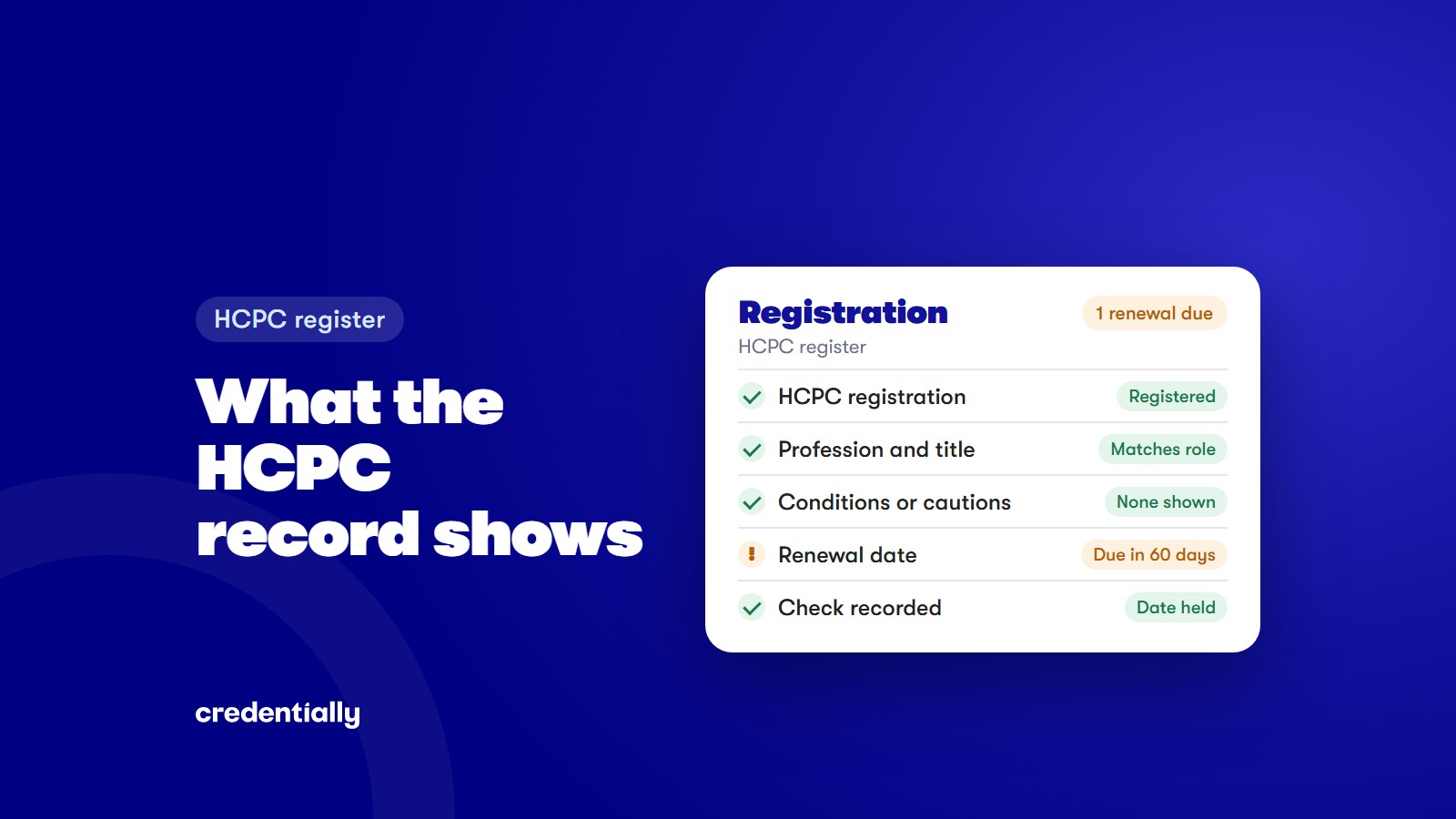
HCPC registration check: what an employer has to verify beyond the name
A compliance officer runs an HCPC registration check on a new physiotherapist and files the result once "Registered" appears beside the right name. The same search for a podiatrist booked to prescribe in a clinic returns the same word. Whether she may prescribe sits in a separate field, the additional entitlements, which a glance at the status passes over.
The Health and Care Professions Council regulates 15 professions [1]. Each entry on its Register carries the profession, a status, any caution or conditions, annotations for medicines and the dates of the current cycle [1], and an HCPC registration check has to read each against the role.
An HCPC registration check starts with the profession and the title
A search needs the profession and "either a person's surname or their registration number", HCPC says [1]. The number is more reliable. It "starts with the letters of the profession code", such as PH for physiotherapists, and opens the individual record directly, while a surname search "might return more than one result" [1].
The prefix places the person in one of the "15 parts to the HCPC Register" [2]. Each profession has titles "protected by law", and "To use one of these titles, an individual must be registered with the HCPC" [3]. HCPC's employer guidance suggests supporting staff by ensuring they "hold the type of registration appropriate for their role" [4].
For practitioner psychologists, HCPC says "Practitioner Psychologist" and "Registered Psychologist" are "not titles that a registrant can solely register under", and advises use of the modality, such as clinical or forensic [3]. The record lists modalities [1], so match the modality to the post.
Some job titles do not line up neatly with the Register. HCPC states that "The title 'sonographer' is not a protected title", though "some employers require registration with the HCPC for those they employ in sonographer positions" [5]. People who dispense hearing aids in the NHS "are not committing a criminal offence if they do so without being HCPC registered as a hearing aid dispenser" [6]. Maxillofacial prosthetists on the Register "are registered as clinical scientists", HCPC said on 28 July 2026 [7]. Your contract and role specification decide what registration to ask for.
An HCPC registration check also cannot confirm the person in front of you is the registrant, because the Register shows no contact details, "Only an approximate geographical location of where they work" [1]. The NHS Employers registration standard asks the check to verify that "the individual is actually the person registered with that regulatory body" [8], and that link has to come from your identity check.
Conditions and interim orders sit on the record, and have to be read against the role
A "Registered" status, according to HCPC's help page, means the person is on the Register with no restrictions, cautions or conditions; any that exist show on the record with a link to further information [1]. The page defines no other status wording, so open that link whenever anything else appears.
Under the sanctions policy dated 2 March 2026, "A caution order is a non-restrictive sanction that will appear on the Register but will not restrict a registrant's ability to practise", and runs for one to five years [9]. A conditions of practice order "allows a registrant to remain in practice subject to restrictions which reflect the panel's finding as to their fitness to practise", for up to three years [9].
Conditions are where an HCPC registration check becomes a judgement. NHS Employers asks the check to confirm "there are no restrictions to their registration that would affect their ability to undertake the duties of the role being offered" [8].
While an investigation runs, interim conditions "might limit the scope of their practice, the places at which they can practise or require them to be supervised when practising", and an interim suspension order "will prevent an employee from practising their profession altogether" [10]. Employers "can find out if an employee is subject to an Interim Order by searching our online Register", HCPC says [10], and an interim order "may be imposed for a maximum period of 18 months" in the first instance [11]. As an illustration, a supervision condition could suit a ward with senior cover and rule out lone community visits.
An open investigation with no order attached
The same standard asks an HCPC registration check to verify that "there are no pending investigations on their fitness to practise that must be considered by the employer" [8]. HCPC's own account reads: "In most cases we will not need to apply for an Order and registrants can continue to practise during an investigation" [11].
HCPC's fitness to practise guidance for employers does not say the Register shows an investigation with no interim order, and the NHS Employers standard does not say where an employer would find one. Beyond interim orders, the sources describe hearing details "including the allegation" published by the Health and Care Professions Tribunal Service 28 days before a final hearing [12], and HCPC's undertaking to notify "you, your chief executive or director of Human Resources if we commence a fitness to practise investigation about your employee" [13].
A clean result from an HCPC registration check therefore shows that no order is in place, a narrower statement than the standard asks for. Write the record so it claims only what the Register showed.
For prescribing roles, an HCPC registration check has to find the annotation
HCPC annotates the Register where a registrant "has obtained entitlements to sell, supply, administer or prescribe these medicines", and states: "We are required to do this by legislation" [14].
The independent prescribing annotation can appear for some chiropodists and podiatrists, physiotherapists, paramedics and therapeutic radiographers. The supplementary prescribing annotation can appear for some chiropodists and podiatrists, physiotherapists, paramedics, radiographers and dietitians, and "A supplementary prescriber can only prescribe the medicines included in the clinical management plan" [14].
HCPC's prescribing page sets two conditions: registrants "must have successfully completed an approved education programme in prescribing", and "They must also have an annotation (mark) on their record on the Register" [15]. A course certificate on file evidences the first, and the Register evidences the second. The duties decide which annotation to look for, since a paramedic prescribing independently needs a different entry from one working to a clinical management plan.
The dates on an HCPC record belong to the profession's cycle
Each profession has its own two-year cycle, and the dates an HCPC registration check returns "reflect the beginning and the end of the profession's current registration cycle" [1]. HCPC adds that they "do not indicate how long a registrant has been qualified or practising" [1], so length of experience has to come from the employment history.
Renewal times "are the same every two years and are staggered throughout the year" [16]. The table on that page, read on 11 November 2026, gave operating department practitioners a window of 1 September to 30 November 2026 [16], and HCPC's renewals page lists the professions in renewal with their deadline [17].
Miss the deadline and the name is removed; the person then "must cease practising and using the protected titles associated with your profession" [18]. HCPC says it will tell the registrant by email; the page says nothing about telling the employer [18]. Its employer guidance stresses checking that staff renew during each window, since otherwise they "may be removed from the Register" [19]. The full calendar is in how a registration lapse happens.
What to record from each HCPC registration check, and how often to repeat it
No guidance from HCPC, the Care Quality Commission or NHS Employers prescribes what to keep from a register check. For providers registered with CQC in England, the Regulation 19(4) guidance says "Providers must have a process to check that staff have appropriate and current registration with a professional regulator" [20]. On HCPC's pages, the nearest thing to a dated record is the Multiple Registrant Search, which checks up to 100 registration numbers at once and shows a timestamp that "confirms when the search was conducted and at what point the data is valid from" [19].
The fields below are reasoned practice, drawn from what the Register displays [1]:
- date and time of the HCPC registration check, and who ran it
- registration number and profession
- status as shown, with the text of any caution or conditions
- modalities and additional entitlements, compared with the duties of the role
- end date of the profession's current cycle
- the individual's consent, which NHS Employers requires alongside the registration number [8]
On frequency, HCPC writes: "We encourage you to check periodically (every 3 to 6 months) that your employees remain registered" [19]. CQC says "Providers must regularly review the fitness of employees" [20]. Neither source sets a required interval.
CQC counts agency and bank staff as persons employed, and where another party ran the checks, "providers must assure themselves that all checks are complete and satisfactory" [20]. Regulation 19 evidence for agency staff covers that split. The other NHS employment checks are set out in what a compliant clinician file contains.
Re-checking HCPC registrations without a manual calendar
With Credentially, automated HCPC registration checks run alongside re-checks of General Medical Council and Nursing and Midwifery Council registrations and the DBS Update Service, with alerts when something changes or approaches expiry. The checks run whether or not anyone logs in, and each one is recorded, so your team has a history whenever evidence is needed. The platform brings back the decisions that need a person; judging whether a condition of practice fits a role stays with your team.
Before your next audit, run the registration numbers of the HCPC registrants on this month's rota through the Multiple Registrant Search and compare each result with the role. Then book a demo and ask to see an HCPC registration check re-run without anyone triggering it, along with the record it leaves.
Frequently asked questions
How do I check if someone is registered with the HCPC?
To check the HCPC Register, search with the person's profession and either their surname or their registration number. The registration number is more precise, because it begins with the profession code and opens the individual record directly. HCPC's Multiple Registrant Search checks up to 100 registration numbers at once.
How often should employers run an HCPC registration check?
HCPC encourages employers to repeat an HCPC registration check every three to six months, and especially around each renewal window, since staff who do not renew may be removed. That interval is guidance. The Care Quality Commission requires providers in England to review the fitness of employees regularly, without naming a frequency.
Why can't I find someone on the HCPC Register?
HCPC's guidance gives four explanations: the person practises under a different name, has removed their name, was removed after a fitness to practise hearing, or the registration number was mistyped. Some job titles, such as sonographer, are not protected, and a sonographer on the Register is registered as a radiographer.
Does HCPC tell employers when a registration lapses?
HCPC says it will email the registrant if their name is removed for not renewing, and its renewal guidance does not describe a notice to the employer. It does say it will notify an employer when it opens a fitness to practise investigation about an employee. For lapses, HCPC's employer guidance stresses checking that staff renew within each window.
References
- Health and Care Professions Council, How to check and find a health and care professional, page updated 10 July 2018, read 11 November 2026. https://www.hcpc-uk.org/check-the-register/how-to-check/
- Health and Care Professions Council, Dual registration, page updated 11 September 2018, read 11 November 2026. https://www.hcpc-uk.org/registration/getting-on-the-register/dual-registration/
- Health and Care Professions Council, Professions and protected titles, page updated 12 May 2025, read 11 November 2026. https://www.hcpc-uk.org/about-us/who-we-regulate/the-professions/
- Health and Care Professions Council, Registration: what you need to know as an employer, page updated 9 October 2019, read 11 November 2026. https://www.hcpc-uk.org/employers/registration/
- Health and Care Professions Council, Registration of Sonographers, page updated 5 February 2019, read 11 November 2026. https://www.hcpc-uk.org/about-us/who-we-regulate/regulation-of-further-professions/registration-of-sonographers/
- Health and Care Professions Council, Protected function: hearing aid dispensers, page updated 12 February 2025, read 11 November 2026. https://www.hcpc-uk.org/about-us/who-we-regulate/the-professions/protected-function/
- Health and Care Professions Council, Use of the title of prosthetist, news item, 28 July 2026, read 11 November 2026. https://www.hcpc-uk.org/news-and-events/news/2026/use-of-the-title-of-prosthetist/
- NHS Employers, Professional registration and qualification checks standard, published 23 July 2026, read 11 November 2026. https://www.nhsemployers.org/publications/professional-registration-and-qualification-checks-standard
- Health and Care Professions Council, Sanctions policy, dated 2 March 2026, published on the Health and Care Professions Tribunal Service site, read 11 November 2026. https://www.hcpts-uk.org/globalassets/resources/policy/sanctions-policy.pdf
- Health and Care Professions Council, Supporting your employee through the fitness to practise process, page updated 12 February 2025, read 11 November 2026. https://www.hcpc-uk.org/employers/managing-concerns/supporting-your-employee-through-ftp/
- Health and Care Professions Council, Interim Orders, page updated 7 July 2025, read 11 November 2026. https://www.hcpc-uk.org/concerns/how-we-investigate/interim-orders/
- Health and Care Professions Tribunal Service, Final hearings, no page date shown, read 11 November 2026. https://www.hcpts-uk.org/hearings/about/finalhearings/
- Health and Care Professions Council, Working with us, page updated 12 February 2025, read 11 November 2026. https://www.hcpc-uk.org/employers/managing-concerns/working-with-us/
- Health and Care Professions Council, Additional entitlements, page updated 22 May 2019, read 11 November 2026. https://www.hcpc-uk.org/check-the-register/additional-entitlements/
- Health and Care Professions Council, Prescribing, page updated 30 July 2026, read 11 November 2026. https://www.hcpc-uk.org/standards/meeting-our-standards/scope-of-practice/medicines-and-prescribing-rights/prescribing/
- Health and Care Professions Council, When to renew, page updated 5 July 2018, read 11 November 2026. https://www.hcpc-uk.org/registration/registration-renewals/when-to-renew/
- Health and Care Professions Council, Registration renewals, page updated 23 February 2026, read 11 November 2026. https://www.hcpc-uk.org/registration/registration-renewals/
- Health and Care Professions Council, What happens if I don't renew, page updated 28 February 2023, read 11 November 2026. https://www.hcpc-uk.org/registration/registration-renewals/what-happens-if-i-dont-renew/
- Health and Care Professions Council, Checking your employees' registration, page updated 4 April 2023, read 11 November 2026. https://www.hcpc-uk.org/employers/registration/checking-your-employees-registration/
- Care Quality Commission, Regulation 19: Fit and proper persons employed, page last updated 16 May 2025, read 11 November 2026. https://www.cqc.org.uk/guidance-regulation/providers/regulations-service-providers-and-managers/health-social-care-act/regulation-19